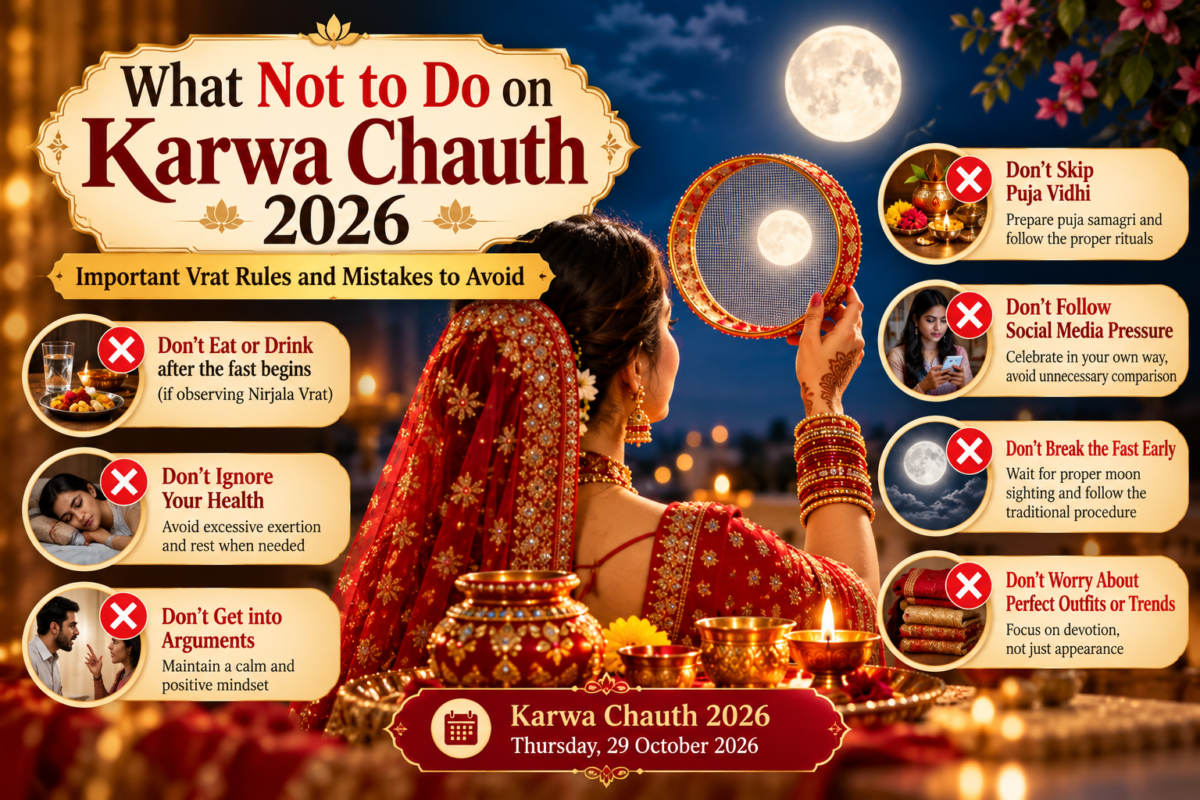
Karwa Chauth 2026 will be observed on Thursday, 29 October 2026. This traditional Hindu festival is celebrated by many married women who observe a fast and pray for their husband’s long life, good health, and marital happiness.
On this auspicious day, following the vrat with devotion, patience, and a peaceful mind is considered important. लेकिन करवा चौथ के व्रत में केवल पूजा करना ही नहीं, बल्कि कुछ पारंपरिक नियमों का ध्यान रखना भी जरूरी माना जाता है।
If you are observing Karwa Chauth this year, here are some common mistakes to avoid, traditional beliefs to know, and practical precautions to keep in mind.
1. Do Not Eat or Drink After the Fast Begins If You Are Following a Nirjala Vrat
Traditionally, many women observe a nirjala vrat, which means fasting without food or water, from sunrise until the Moon is sighted and the evening rituals are completed.
Sargi is generally eaten before sunrise, after which the fast begins according to the family’s tradition.
What to avoid:
- Do not accidentally eat after your fast has started if you have chosen to observe a strict vrat.
- Do not forget to plan your Sargi and puja preparations in advance.
- Do not assume every family follows exactly the same fasting rules.
Important: A strict waterless fast is not suitable for everyone. If you are pregnant, unwell, taking medication, or have a medical condition, prioritise your health and seek medical advice. You can honour the spiritual significance of the day through prayer and a modified fast.
2. Do Not Ignore the Karwa Chauth Puja Vidhi
Evening puja is an important part of Karwa Chauth. Many families worship Goddess Parvati, Lord Shiva, Lord Ganesha, and the Moon according to their customs.
Common mistakes to avoid:
- Leaving the puja arrangements until the last minute.
- Forgetting essential puja samagri, such as a diya, karwa, flowers, roli, and offerings.
- Skipping the vrat katha when it is part of your family’s tradition.
- Performing rituals in a hurry without understanding their meaning.
It is helpful to prepare the puja thali and other items beforehand. If you are unsure about a particular ritual, consult a knowledgeable pandit or follow your family’s established tradition.
3. Do Not Break the Fast Before Moon Sighting Without Understanding Your Tradition
Traditionally, the Karwa Chauth fast is completed after the Moon is sighted, followed by the prescribed offering of arghya and the customary fast-breaking ritual.
What to remember:
- Check the expected local Moon-sighting time.
- Do not rely entirely on a generic online timing, as moonrise differs by location.
- Follow your family’s customary sequence for viewing the Moon, offering arghya, and breaking the fast.
For Mumbai, the Moon-sighting time is estimated at around 8:56 PM on 29 October 2026, although actual visibility and local conditions may vary. Confirm the timing with a location-specific Panchang closer to the date.
If you begin feeling seriously unwell, however, do not delay necessary food, water, or medical assistance merely to complete the ritual. Health and safety come first.
4. Do Not Get Involved in Arguments or Negative Behaviour
Karwa Chauth is traditionally associated with love, devotion, and marital harmony. Many families therefore encourage devotees to maintain a calm and positive mindset during the vrat.
Try to avoid:
- Unnecessary arguments or hurtful words.
- Speaking disrespectfully to family members.
- Lying, gossiping, or deliberately hurting someone.
- Creating stress over small mistakes during the rituals.
व्रत का उद्देश्य केवल भूखे-प्यासे रहना नहीं, बल्कि श्रद्धा, संयम, प्रेम और सकारात्मक सोच के साथ पूजा करना भी है।
Remember that a disagreement does not automatically invalidate your vrat. Focus on resolving conflicts kindly rather than feeling guilty over every small imperfection.
5. Do Not Treat Every Traditional Clothing Rule as Universal
Red, maroon, pink, orange, and other festive colours are popular choices for Karwa Chauth. Many women wear traditional attire, jewellery, bangles, and mehndi as part of the celebration.
Some families traditionally avoid wearing black or white on auspicious occasions. However, clothing customs differ by region and household.
A few things to keep in mind:
- Follow your family’s customary dress code if you wish.
- Choose comfortable clothing, especially if you will be fasting throughout the day.
- Do not feel that your devotion depends entirely on wearing a particular colour or outfit.
Traditional beliefs about clothing should be understood in their cultural context rather than treated as universal religious rules.
6. Do Not Ignore Your Health During the Fast
This is one of the most important precautions for Karwa Chauth 2026.
A long fast without water can cause dehydration, weakness, headaches, and dizziness, particularly in hot weather or for people with existing health concerns.
Avoid these mistakes:
- Starting the day without adequate preparation.
- Doing strenuous exercise or spending too much time in the heat.
- Ignoring severe weakness, faintness, confusion, or persistent dizziness.
- Continuing a strict fast despite medical advice to the contrary.
If you are pregnant, breastfeeding, elderly, diabetic, or taking medicines that require food or water, discuss fasting with a healthcare professional beforehand. Do not stop or alter prescribed medication on your own.
If you develop concerning symptoms, stop fasting and seek appropriate medical help. A modified vrat, prayer, or puja can still be meaningful.
7. Do Not Forget to Prepare Sargi in Advance
Sargi is the pre-dawn meal traditionally prepared or offered by the mother-in-law in many families. Its customs and contents vary.
To make the morning easier, avoid:
- Waiting until the last minute to arrange Sargi.
- Skipping your usual preparation without a plan.
- Eating unfamiliar foods that may upset your stomach.
- Assuming that every family must prepare exactly the same items.
Depending on your family’s tradition, Sargi may include fruits, nuts, sweets, or other foods. If you are observing a modified fast for health reasons, plan suitable food and fluids with your healthcare professional.
8. Do Not Forget the Moon-Sighting Ritual and Arghya
Moon sighting is a central part of the traditional Karwa Chauth observance for many families.
The customary ritual may include looking at the Moon through a sieve (channi), viewing one’s husband, offering water to the Moon, and then breaking the fast. The exact sequence can vary.
What to avoid:
- Waiting until the evening to arrange the sieve, karwa, diya, and puja thali.
- Assuming the Moon will be visible at the same time in every city.
- Confusing the published moonrise time with guaranteed visibility through clouds or buildings.
Prepare the essentials early and follow your family’s customary ritual. If the Moon is obscured by clouds, ask your family priest about the practice followed in your tradition rather than assuming that one method applies to everyone.
9. Do Not Assume That Every Custom Is Mandatory for Everyone
Karwa Chauth traditions vary across North India, Maharashtra, and other regions. Some families follow additional customs, while others observe a simpler vrat.
For example, practices concerning daytime sleep, stitching, cutting hair or nails, donating certain foods, and the colours worn on the day may differ by family and regional tradition.
It is best to distinguish between:
- Core rituals in your family tradition: Follow these according to your beliefs and circumstances.
- Regional customs: Observe them if they are meaningful to you.
- Popular claims or superstitions: Verify them instead of assuming that every claim is a universal religious rule.
श्रद्धा और परंपरा का सम्मान करें, लेकिन अनावश्यक डर या दबाव में आकर कोई निर्णय न लें।
10. Do Not Let Social Media Pressure Spoil Your Celebration
Karwa Chauth is often shown through elaborate outfits, expensive gifts, beautifully decorated thalis, and picture-perfect celebrations. These can be enjoyable, but they are not a measure of devotion.
Avoid comparing your celebration with other people’s photos or videos. You do not need expensive jewellery, elaborate decorations, or a lavish dinner to observe the festival meaningfully.
Spend the day in a way that suits your beliefs, family customs, health, and budget. प्रेम, सम्मान और आपसी समझ किसी भी दिखावे से अधिक महत्वपूर्ण हैं।
Quick Checklist: Karwa Chauth 2026 Mistakes to Avoid
Before the festival, review this checklist:
- Confirm the date and local puja and Moon-sighting timings.
- Prepare Sargi and puja samagri in advance.
- Understand your family’s vrat and fast-breaking traditions.
- Avoid arguments and try to maintain a peaceful mindset.
- Do not ignore symptoms of dehydration or illness.
- Follow your family’s clothing and ritual customs without unnecessary fear.
- Keep the sieve, karwa, diya, and puja thali ready.
- Do not treat social media trends or regional customs as universal requirements.
Frequently Asked Questions (FAQs)
1. What should we not do on Karwa Chauth 2026?
Traditionally, devotees try to avoid eating after the fast begins, rushing through the puja, missing customary rituals, and engaging in hurtful or disrespectful behaviour. Exact rules vary by family and region. Health-related needs should always be taken seriously.
2. Can I drink water during Karwa Chauth?
A traditional nirjala vrat excludes water, but not everyone should undertake such a fast. People who are unwell, pregnant, taking certain medications, or at risk of dehydration should seek medical advice and may need to modify or avoid fasting.
3. Is it compulsory to wear red on Karwa Chauth?
Red is a popular and auspicious colour in many traditions, but wearing red is not a universal requirement. Follow your family’s customs and choose clothing that makes you comfortable.
4. Can I sleep during the day on Karwa Chauth?
Some families traditionally discourage daytime sleeping during the vrat, while practices differ across households. Resting when you feel tired or unwell is important, particularly during a long fast.
5. What if the Moon is not visible on Karwa Chauth?
Cloud cover can delay actual Moon sighting even after the calculated moonrise time. Follow the guidance of your family or local pandit regarding the customary ritual. Do not put your health at risk while waiting.
6. What if I accidentally break a Karwa Chauth rule?
Do not panic. Customs and interpretations vary, and an accidental mistake does not need to become a source of fear. If you are concerned about a specific ritual, consult a trusted pandit from your tradition.
7. When is Karwa Chauth in 2026?
Karwa Chauth will be observed on Thursday, 29 October 2026. Puja and Moon-sighting times depend on your location, so check a local Panchang before the festival.
Conclusion
Karwa Chauth is a festival of devotion, love, and marital togetherness. Understanding what not to do on Karwa Chauth 2026 can help you prepare for the vrat, respect family traditions, and avoid common mistakes.
सबसे जरूरी बात यह है कि व्रत को श्रद्धा, शांति और समझदारी के साथ रखें। परंपराओं का सम्मान करें, अपने स्वास्थ्य का ध्यान रखें और इस दिन को प्रेम तथा सकारात्मकता के साथ मनाएं।
Need help with Karwa Chauth puja? Visit AapkaPandit.com to explore pandit services and get guidance for traditional puja rituals, according to your family’s customs.
Disclaimer: This article describes common religious and regional practices for informational purposes. Rituals may vary by family and location. Health-related fasting decisions should be discussed with a qualified healthcare professional.